Artists like Rubén González
Kindred artists that sit next to Rubén González on the star chart — same era, adjacent sound, or overlapping influence. Tap any card to open its full page.
 Ibrahim Ferrerartist
Ibrahim Ferrer was a Cuban singer who played with the group Los Bocucos for nearly forty years. He also performed with Conjunto Sorpresa, Chepín y su Orquesta Oriental, and Mario Patterson. After his retirement in 1991, he was brought back in the studio to record with the Afro-Cuban All Stars and Buena Vista Social Club, in March 1996. He then toured internationally with these revival groups and recorded several solo albums for World Circuit, before his death in 2005.
 Omara Portuondoartist
Omara Portuondo Peláez is a Cuban singer and dancer. A founding member of the popular vocal group Cuarteto d'Aida, Portuondo has collaborated with many important Cuban musicians during her long career, including Julio Gutiérrez, Juanito Márquez and Chucho Valdés. Although primarily known for her rendition of boleros, she has recorded in a wide range of styles from jazz to son cubano. Since 1996, she has been part of the Buena Vista Social Club project, touring extensively and recording several albums with the ensemble. She won a Latin Grammy Award for Best Contemporary Tropical Album in 2009, a Latin Grammy Award for Best Traditional Tropical Album in 2023, a Latin Grammy Lifetime Achievement Award in 2019, and she received three Grammy Award nominations in 2019 and a nomination in 2024.
 Compay Segundoartist
Máximo Francisco Repilado Muñoz Telles, known professionally as "Compay Segundo", was a Cuban trova guitarist, singer and composer.
 Buena Vista Social Clubartist
Buena Vista Social Club was a musical ensemble primarily made up of Cuban musicians, formed in 1996. The project was organized by World Circuit executive Nick Gold, produced by American guitarist Ry Cooder and directed by Juan de Marcos González. They named the group after the members' club of the same name in the Buenavista quarter of Havana, a popular music venue in the 1940s. To showcase the popular styles of the time, such as son, bolero and danzón, they recruited a dozen veteran musicians, some of whom had been retired for many years.
 Eliades Ochoaartist
Eliades Ochoa Bustamante is a Cuban guitarist and singer from Loma de la Avispa, Songo La Maya in the east of the country near Santiago de Cuba.
 Afro-Cuban All Starsartist
Afro-Cuban All Stars is a Cuban band led by Juan de Marcos González. Their music is a mix of all the styles of Cuban music, including bolero, chachachá, salsa, son montuno, timba, guajira, danzón, rumba and abakua.
 Sierra Maestraartist
Sierra Maestra are a Cuban band started in 1976. They sought to revive 1920s classic son, which came from the mountain range on the east of Cuba, after which the band was named.
 Vieja Trova Santiagueraartist
 Mongo Santamariaartist
Ramón "Mongo" Santamaría Rodríguez was a Cuban percussionist and bandleader who spent most of his career in the United States. Primarily a conga drummer, Santamaría was a leading figure in the pachanga and boogaloo dance crazes of the 1960s. His biggest hit was his rendition of Herbie Hancock's "Watermelon Man", which was inducted into the Grammy Hall of Fame in 1998. From the 1970s, he recorded mainly salsa and Latin jazz, before retiring in the late 1990s.
 Bebo Valdésartist
 Ray Barrettoartist
Raymundo "Ray" Barretto Pagán was an American percussionist and bandleader of Puerto Rican descent. Throughout his career as a percussionist, he played a wide variety of Latin music styles, as well as Latin jazz. His first hit, "El Watusi", was recorded by his Charanga Moderna in 1962, becoming the most successful pachanga song in the United States. In the late 1960s, Barretto became one of the leading exponents of boogaloo and what would later be known as salsa. Nonetheless, many of Barretto's recordings would remain rooted in more traditional genres such as son cubano. A master of the descarga, Barretto was a long-time member of the Fania All-Stars. His success continued into the 1970s with songs such as "Cocinando" and "Indestructible". His last album for Fania Records, Soy dichoso, was released in 1990. He then formed the New World Spirit jazz ensemble and continued to tour and record until his death in 2006. He is the father of American vocalist and saxophonist Chris Barretto, best known for being the former singer of progressive metal bands Monuments and Periphery.
 Carlos Pueblaartist
Carlos Manuel Puebla was a Cuban singer, guitarist and composer. He was a member of the Trova movement, who specialized in boleros and patriotic songs.
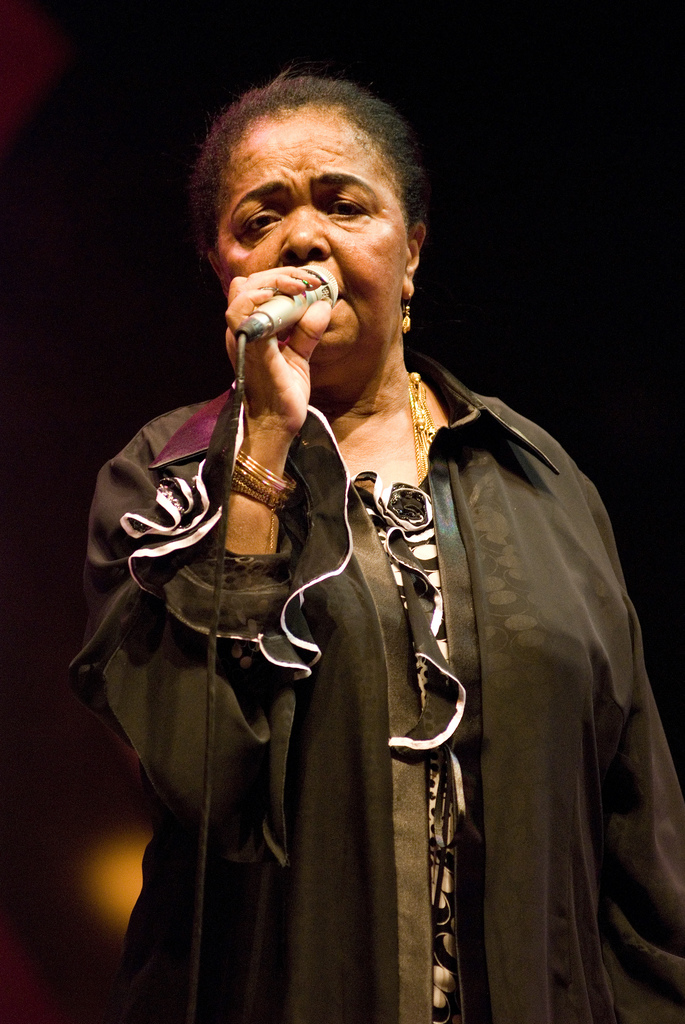 Cesária Évoraartist
Cesária Évora GCIH was a Cape Verdean singer known for singing morna, a genre of music from Cape Verde, in her native Cape Verdean Creole. Her songs were often devoted to themes of love, homesickness, nostalgia, and the history of the Cape Verdean people. She was known for performing barefoot and for her habit of smoking and drinking on stage during intermissions. Évora's music received many accolades, including a Grammy Award in 2004, and it has influenced many Cape Verde diaspora musicians as well as American pop singer Madonna. Évora is also known as Cize, the Barefoot Diva, and the Queen of Morna.
 Orishasartist
Orishas are a Cuban hip hop group from Havana, Cuba, founded in 1999. The group was first called "Amenaza", "threat" or "menace" in Spanish, and appealed to the Cuban youth. The choice of this name for the hip hop group is a way of creating a direct link between this band and the African diaspora. The group is based in France where they made a deal with a record company, although they visit Cuba frequently. In 1999 Fidel Castro threw a party for them and had a meeting with all the musicians. It was the first time the Cuban government showed support for hip hop music. The group was and still is popular in Europe and Latin America. Yotuel Romero and Ruzzo Medina, who moved from Havana to Paris as part of an international studies program, joined Roldán González and Flaco-Pro to form the band in 1999. Their work is influenced by the hip hop movement as well as Cuban and other Latin rhythms. As of November 2024, they had produced a total of five studio albums and a greatest hits album; their latest album is Gourmet. In 2009 they participated in the concert Paz Sin Fronteras II in Plaza de la Revolución, Havana, Cuba. Orishas reunited to record new material in 2016.
 Pérez Pradoartist
Dámaso Pérez Prado was a Cuban bandleader, pianist, composer and arranger who popularized the mambo in the 1950s. His big band adaptation of the danzón-mambo proved to be a worldwide success with hits such as "Mambo No. 5", earning him the nickname "The King of the Mambo". In 1955, Pérez Prado and his orchestra topped the charts in the US and UK with a mambo cover of Louiguy's "Cherry Pink ". He frequently made brief appearances in films, primarily of the rumberas genre, and his music was featured in films such as La Dolce Vita.
 Joe Cuba Sextetartist
 Los Van Vanartist
Los Van Van is one of the leading musical groups of post-revolutionary Cuba. It was founded in 1969 by bassist Juan Formell, who directed the band until his death in 2014. Formell and former band members Changuito and Pupy are some of the most important figures in contemporary Cuban music, having contributed to the development of songo and timba, two popular dance music genres.
 La Sonora Matanceraartist
La Sonora Matancera is a Cuban band that played Latin American urban popular dance music. Founded in 1924 and led for more than five decades by guitarist, vocalist, composer, and producer Rogelio Martínez, musicologists consider it an icon of this type of music. Notable singers to have sung and recorded with the band include Bienvenido Granda, Daniel Santos, Myrta Silva, Miguelito Valdés, Leo Marini, Celia Cruz, Nelson Pinedo, Vicentico Valdés, Estanislao "Laíto" Sureda, Alberto Beltrán, Carlos Argentino, and Celio González.
 La Lupeartist
 Michel Camiloartist
 Rubén Bladesartist